The Truth about Lung Cancer

Jean Calment, who stopped smoking at the age of 117
Everyone knows smoking causes lung cancer. But if that’s true, how do you explain Jeanne Calment, the oldest verified person in history, who lived to the age of 122 and only quit smoking at the age of 117, just five years before she finally died of old age?
I frequently coach people whose aged parents in their 80s smoke, and while they might have some health problems they refuse to quit, and also do not have lung cancer. While it appears to make sense that smoking might cause lung cancer—it is breathing in smoke, after all—the data is actually pretty sus.
Like me, have you ever wondered why there is a known association with smoking cigarettes and lung cancer but not marijuana? Which is ultimately also the same act of burning leaves and breathing in the smoke. While plants can vary in their chemical composition, and cigarettes can contain lots of added harmful chemicals, is this a problem of tobacco? One study claims that smoking pot raises lung cancer risk by a factor of 2, while the CDC claims smoking tobacco raises it by 15 to 30 times which, besides being an absurd factor, is also quite the spread of values. Which is it? 15? Or 30? Isn’t this science?
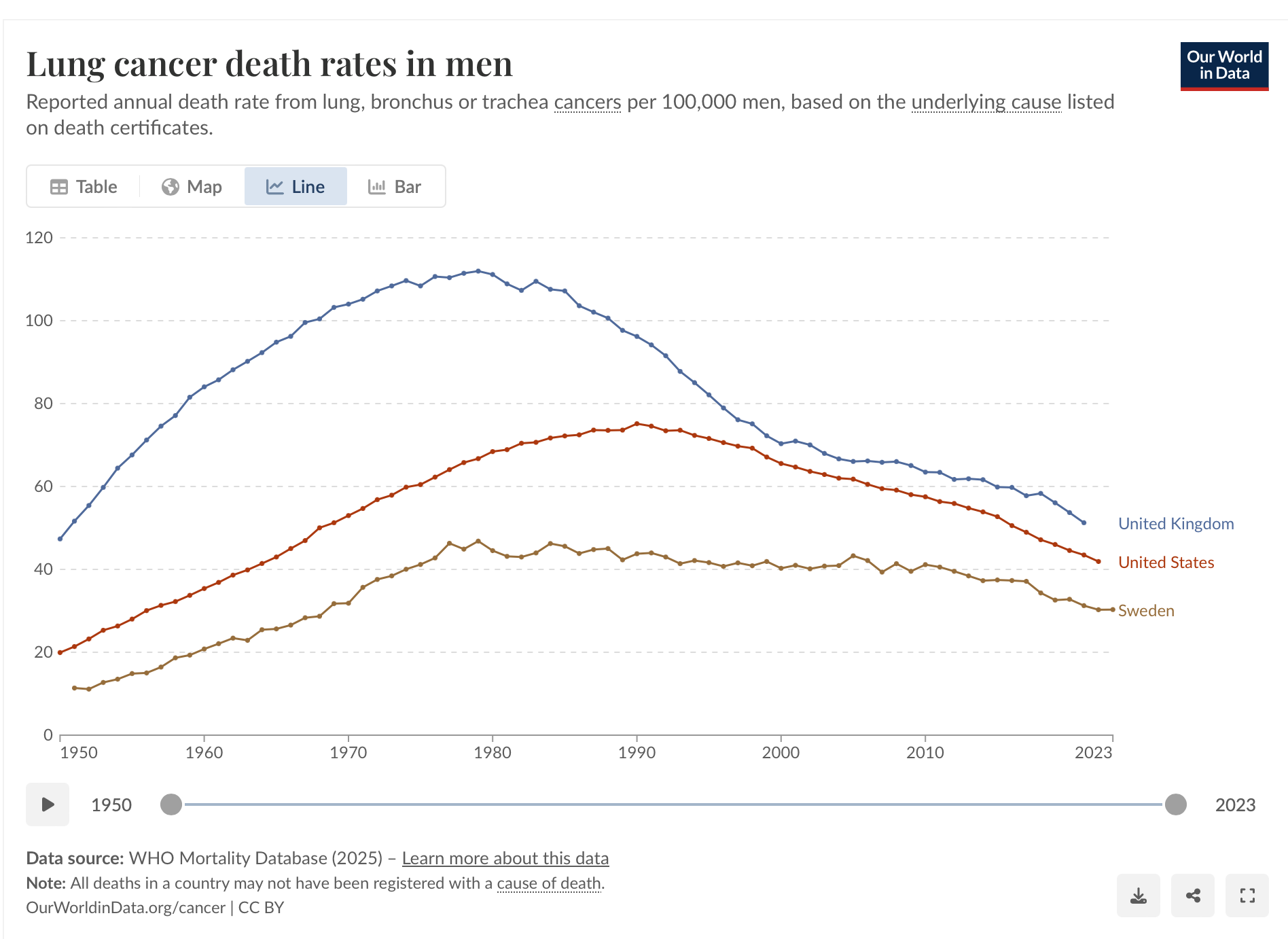
This is a chart of the lung cancer death rates in men since 1950, and by looking at the data, if you squint, you might be able to find some association with rates of smoking in the other graph below. But there is a major problem with the narrative which is that rates of smoking in the USA actually began to decline from the 1950s at the lowest rate of lung cancer deaths in the above dataset, yet the rate of lung cancer deaths continue climbing in the USA until 1990, even when rates of smoking had dropped to about 28% from the high of 45%, and rates of lung cancer deaths do not align with the rate of smoking even slightly.
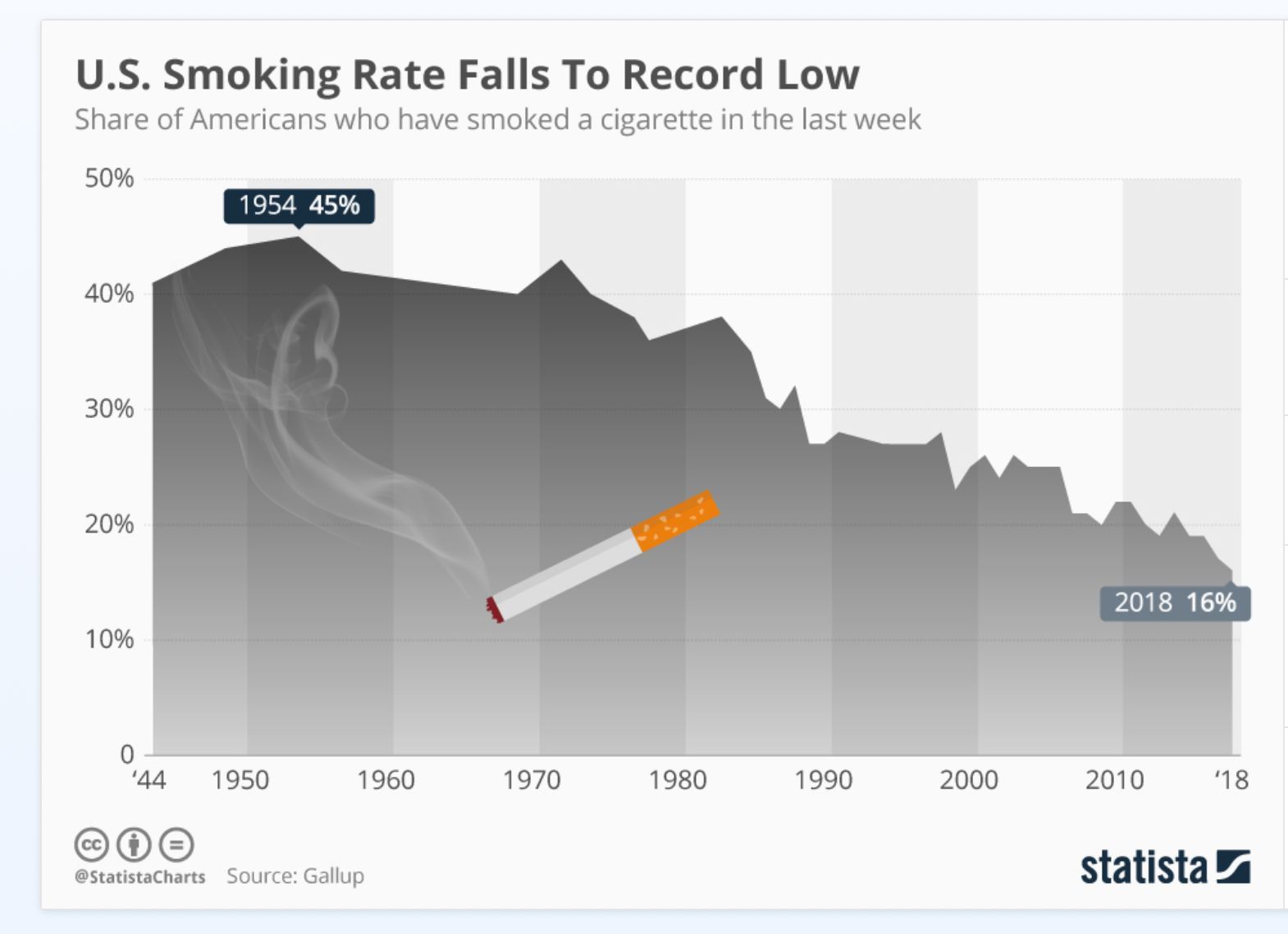
What’s even more interesting is the rate of lung cancer deaths in the United Kingdom which can be seen to peak about 50% greater than the lung cancer deaths in the United States. From that data and assuming that smoking is the primary cause of lung cancer as is so commonly claimed, the UK should then have a higher rate of smoking? In 1948, two years before the lung cancer rate chart above even starts and at the lowest rate of lung cancer in the dataset an insane 82% of British males smoked tobacco. Yet by the peak of lung cancer deaths in the UK around 1980 the rate of smoking had declined to around 35%, which is the same as the rate in the US at the time. Why was the UK rate of lung cancer nearly three times higher in 1980 but peak tobacco use was in 1948? Why was the rate of lung cancer lowest when the rate of smoking was highest?
It’s also not like smoking was new in the 1940s. Tobacco had been a major world cash crop for several centuries at this point. Along with cotton and sugar it was one of the primary reasons that white Europeans colonized and genocided of the Americas from the late 1600s onward. By 1800 tobacco commercialization and use was worldwide. So to have such a low rate of lung cancer in 1950 without considering the high prevalence of tobacco use for the previous few hundred years is just plain incompetence. Or is it misdirection?
It’s pretty insane how incongruous the data is between claims of smoking and lung cancer. I do not believe smoking is healthy, and there are real problems I have observed such as when I tried to become a smoker 6 years ago (I didn’t get hooked) when it stopped my hair regrowth progress, likely due to the vasoconstrictive effect of nicotine on the cardiovascular system which would then lower blood circulation to the scalp (update: I have since discovered this caused by arginine deficiency as discussed in the latest update of my book F*ck Portion Control) but there is definitely not sufficient data to prove that smoking tobacco increases the rate of lung cancer by much, if at all, and certainly not 15 to 30 times, and is probably a much more reasonable factor such as with smoking marijuana, which is 2.
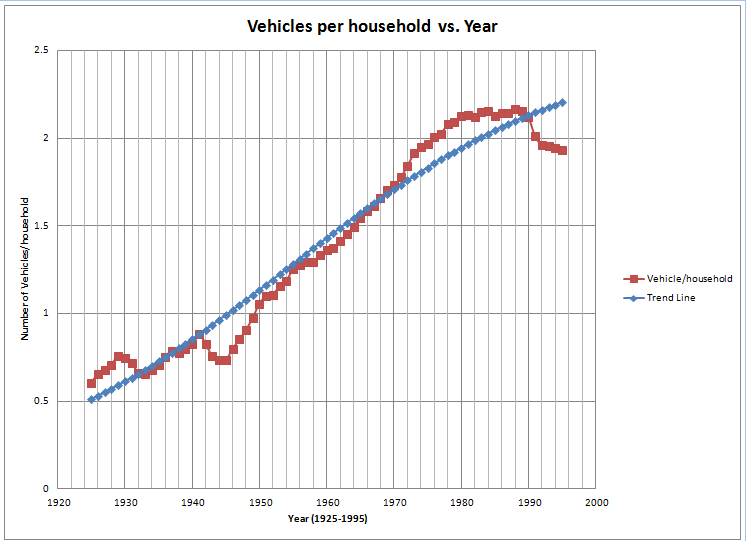
There is, however, a major factor which does correlate with the data of lung cancer deaths, and that is leaded gasoline which, unlike tobacco, started being used in the 1920s and was not meaningfully addressed until the 1970s to the 1990s, with Algeria being the very last country to outlaw it just five years ago in 2021. Lead is a well established carcinogen, besides being in old pipes, paint, and other industrial uses it was added to the gasoline for motor vehicles and became airborne in the exhaust. The increase in rates of lung cancer better correlate with the adoption rates of driving and thus use of leaded gasoline and exposure to leaded motor vehicle exhaust. Unlike rates of smoking, bans on leaded gasoline correlate exactly with the rise and decline in lung cancer rates, where for instance the UK’s shift to unleaded started in the late 1970s, exactly when their rates of lung cancer stop rising. Though it did not become a complete ban until later, there was early and widespread adoption of unleaded. While Sweden’s ban began in 1978, also exactly when their rates of cancer stop rising, it was also gradually implemented and not finalized until 1995. The USA’s ban did not come until later, with a partial ban in 1985, which is why their rate of lung cancer deaths did not stop slowing until well after the UK and Sweden, and wasn’t fully completed until 1996 when rates were finally on the decline.
While rates of lung cancer have been declining the decline is also very slow and probably correlates with the slow elimination of lead from the environment, as a recent study found that airborne lead particles still exist in London even today. I also happened on an article and study, however, which shows that lung cancer rates in Sweden have not correlated with smoking rates at all, and has even risen in some cases, and it is likely there could be some unknown environmental lead problem or some other unknown carcinogen factor. But it is clear from the data that smoking is not even remotely as associated with the spikes in lung cancer which occurred in the last half of the previous century as has been previously claimed, but instead was a misunderstanding, or purposeful distraction, from the harms caused by leaded gasoline.
It is also not known (as this is a discovery from my own academic work) that smoking and nicotine are not actually addictive, which is why I did not get addicted when I tried to smoke during my time in recovery, but instead is a self-medication behavior for the high amounts of cyanide in tobacco smoke, which serves to temporarily scavenge a great deal of oxidative stress and helps fight opportunistic pathogens (also temporarily), as cyanide is a substrate for immune cells used to kill invasive microbes, and that tobacco/nicotine addiction is in fact a consequence of not having enough dietary cyanide, which can be resolved through the daily consumption of cyanogenic foods like brassicas (broccoli, arugula, cabbage, etc.), yuca, bamboo shoots, almonds, apple seeds, etc., as discussed in my book, F*ck Portion Controlin the chapters on immunity and addiction (there is also an addiction guide here).
Nicotine is also a niacin mimmic (vitamin B3) which produces much of the same effects on the body as niacin. The names of niacin and nicotine being similar is also NOT a coincidence as the real scientific name of niacin is nicotinic acid which, yes, is also the scientific name of nicotine, and this happened because the very first synthetic niacin was actually made FROM NICOTINE. When industrial food producers later began adding vitamin B3 to fortified bread people thought they were being dosed with nicotine, and nicotinic acid was then renamed to niacin as a fucking marketing term, not a scientific one. So smoking and using nicotine is like a form of supplementation for niacin which is therapeutic to people with disruptions in the kynurenine pathway as discussed in the chapter Niacin Therapy in F*ck Portion Control.
Cancer is generally caused by factors which interrupt the mechanism of mitochondrial respiration as also discussed in my book, primarily due to the loss of mitochondrial silicon, and lead is in the same periodic group as silicon and likely promotes cancer by displacing silicon which is necessary for proper function of mitochondria, and anyone with cancer can start at my cancer guide to learn how to treat it. Two years ago I discovered the Solution to the Warburg Effect which is the underlying mechanism of action of most cancer, and is mediated by loss of silicon from mitochondria which disrupts the mitochondrial production of energy through respiration because silicon is a semiconductor which insulates mitochondria against electron leakage. In support of this discovery it then explains the carcinogenicity of lead because lead is in the same periodic table group as silicon and can thus be inserted into silicon pathways but is not a semiconductor and therefore initiates Warburg metabolism by displacing silicon.
There is no paywall for this information and all my ebooks are donation based (on income level). I am only able to do this work because of people like you who buy my books or contribute to my Patreon where I post notifications about articles and real-time updates to my research (there is a free option on Patreon too). If you appreciate these articles, considering being one of them.